1310 vs. 1350 U-Joints: The Ultimate Driveline Upgrade Guide
When building a reliable off-road rig, muscle car, or tow vehicle, your driveshaft’s universal joints (U-joints) are the critical links keeping power moving to your wheels. If you are ordering a custom driveline, you will inevitably face a choice: Should you stay with a 1310 series or upgrade to a heavy-duty 1350 series?
Understanding how these sizes differ in strength, dimension, and real-world application is the key to preventing a catastrophic failure on the trail or track.
What Are U-Joints and Why Do They Matter?
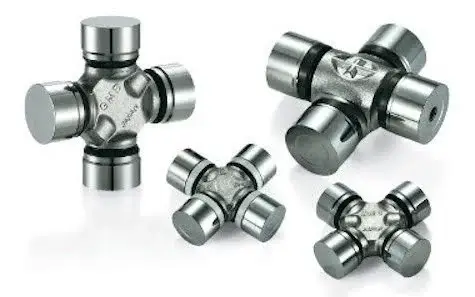
Universal joints (U-joints) are flexible, cross-shaped connectors sitting at each end of a driveshaft. They allow the shaft to rotate smoothly and continuously transfer power even as your vehicle’s suspension moves up and down, altering the driveline angle.
Upgrading your U-joint series doesn’t just mean changing the cross itself—it means your yokes, companion flanges, and the driveshaft tubing are all upgraded to larger, significantly thicker components.
What is the Difference Between 1310 and 1350 Series Joints?
The core difference between a 1310 and a 1350 series joint comes down to physical dimensions and ultimate yield strength:
- 1310 Series (“The Half-Ton Standard”): This is the classic factory standard found in most stock Jeeps, half-ton pickup trucks, and classic muscle cars. It uses a cap diameter of 1.062 inches and a body width of 3.219 inches.
- 1350 Series (“The One-Ton Muscle”): Found stock in heavy-duty 1-ton commercial trucks, the 1350 series is built for brutal punishment. It features a larger 1.188-inch cap diameter and a 3.625-inch body width.
1350 U-Joint: Pros and Cons
- Pros: Offers roughly 37.5% more torque handling capacity than a 1310 joint. It delivers unmatched durability, handles extreme shock loads, and provides complete peace of mind.
- Cons: Higher initial cost. Upgrading requires changing out your transfer case and differential yokes. Additionally, because of the larger body size, a standard 1350 joint can have slightly less angular flexibility (operating angle clearance) before binding compared to a 1310.
When Should You Consider Upgrading to 1350 U-Joints?
A 1350 upgrade isn’t always mandatory, but it becomes necessary when your vehicle hits certain performance thresholds:
1. Tire Sizes of 35 Inches or Larger
Large, heavy off-road tires create massive rotational mass. When crawling over rocks or spinning through mud, the leverage exerted by a 35-inch, 37-inch, or 40-inch tire places immense strain on the driveline that can easily snap a stock 1310 joint.
2. High Horsepower and High Torque
If you have swapped in a V8 engine, added a supercharger, or built a high-performance track engine, the severe torque output will rapidly twist or break weaker factory joints.
3. Low-Gear Ratios (Heavy Load)
A common point of confusion is gear ratios. Numerically lower gear ratios (such as 3.21, 3.55, or 3.73) mean your driveshaft spins slower but carries a much higher torque load per rotation to move the vehicle. Conversely, numerically higher ratios (like 4.88, 5.13, or 5.38) multiply torque at the axle, meaning the driveshaft spins faster but with less structural effort. If you are running low numerical highway gears with large tires, your driveshaft is working overtime.
4. Heavy Overland Builds and Towing
Weight kills drivetrain parts. If your rig is loaded down with steel bumpers, winches, rooftop tents, and overland gear—or if you frequently tow heavy trailers—the constant load requires 1350-level strength.
5. Aggressive Driving Styles
If your driving style dictates a “when in doubt, send it” mentality, structural insurance is mandatory. Shock loading—like bouncing on a ledge and landing with the throttle wide open—is the number one cause of broken U-joints.
Front vs. Rear Driveshaft Priorities
Because your vehicle operates in 2WD on the street most of the time, your rear driveshaft is the primary driver and shoulders the bulk of the work.
- The Rear Shaft: Should almost always be upgraded first. If budget allows, a 1350 rear shaft is highly recommended for any modified vehicle.
- The Front Shaft: Can often remain a 1310 or a hybrid joint longer because it only splits the load when 4WD is fully engaged.
Advanced Driveline Factors to Consider
1. The Myth of the Driveline “Fuse” (Trail Repairs vs. Reality)
Many off-roaders deliberately choose a 1310 series joint because they want a cheap, $25 “fuse” that breaks before an expensive transfer case or differential gear set does. While this sounds good in theory, trail reality is very different.
When a 1310 joint fails under heavy throttle, it rarely breaks cleanly. The cross usually grenades, instantly splaying the driveshaft ears or twisting the yoke. Once those component ears are warped, you cannot simply press a new U-joint in on the trail—the entire driveshaft is ruined. Upgrading to a 1350 prevents the failure altogether rather than gambling on a messy trail fix.
2. Generational Axle Upgrades (Why Vehicle Year Matters)
Axle names can be deceiving. For example, a modern factory Dana 44 found in a newer Jeep JK or JL platform is a completely different animal than an old Dana 44 from a Jeep TJ. Modern vehicle platforms feature significantly thicker pinion shafts, stronger differential gears, and larger transfer cases built to withstand massive stress. Because your stock surrounding components are already so robust, they can easily handle the strength of a 1350 upgrade without passing a breaking point down the line.
3. Short Wheelbase Angle Restrictions (2-Door vs. 4-Door)
Your vehicle’s wheelbase length heavily impacts which series can physically clear your suspension lift. Short wheelbase rigs—such as 2-door Jeeps or short-bed classic trucks—experience much steeper driveshaft operating angles when lifted. Because a 1350 U-joint has a physically larger body, it has less internal clearance and will bind at a shallower operating angle than a 1310. If you have a short-wheelbase vehicle with a massive lift, a high-clearance 1310 or a highly specialized high-angle custom shaft may be required to clear the angles without binding.
4. Note for Upgrading Vehicles with Stock Shafts
If you are planning to buy a spare U-joint to keep in your rig for a factory driveshaft, be aware that many modern stock 4x4s do not use standard 1310 or 1350 cross-joints from the factory. Instead, modern platforms frequently use enclosed Rzeppa-style CV joints on the transfer case side. Upgrading to a durable, traditional 1310 or 1350 double-cardan setup requires replacing the entire factory driveshaft and changing out the stock companion flanges for custom output yokes.
Build with Room to Grow at JE Reel Driveline
Don’t wait to get stranded on a trail with a snapped driveshaft. At JE Reel Driveline, we carry an extensive inventory of high-strength 1310 series parts, heavy-duty 1350 series setups, and custom yokes to handle everything from mild daily drivers to extreme King of the Hammers race rigs.
Unsure which setup aligns with your tire size, gear ratio, and application? Follow our step-by-step blueprint on how to measure a driveshaft to gather your specs, then consult with one of our driveline pros to engineer your perfect setup.
Call Our Tech Line: 909-629-9002
Email Us: contact@reeldriveline.com